
Harnessing Curiosity at Rohi's Readery
By Kathleen Cuéllar. Written September 8, 2026
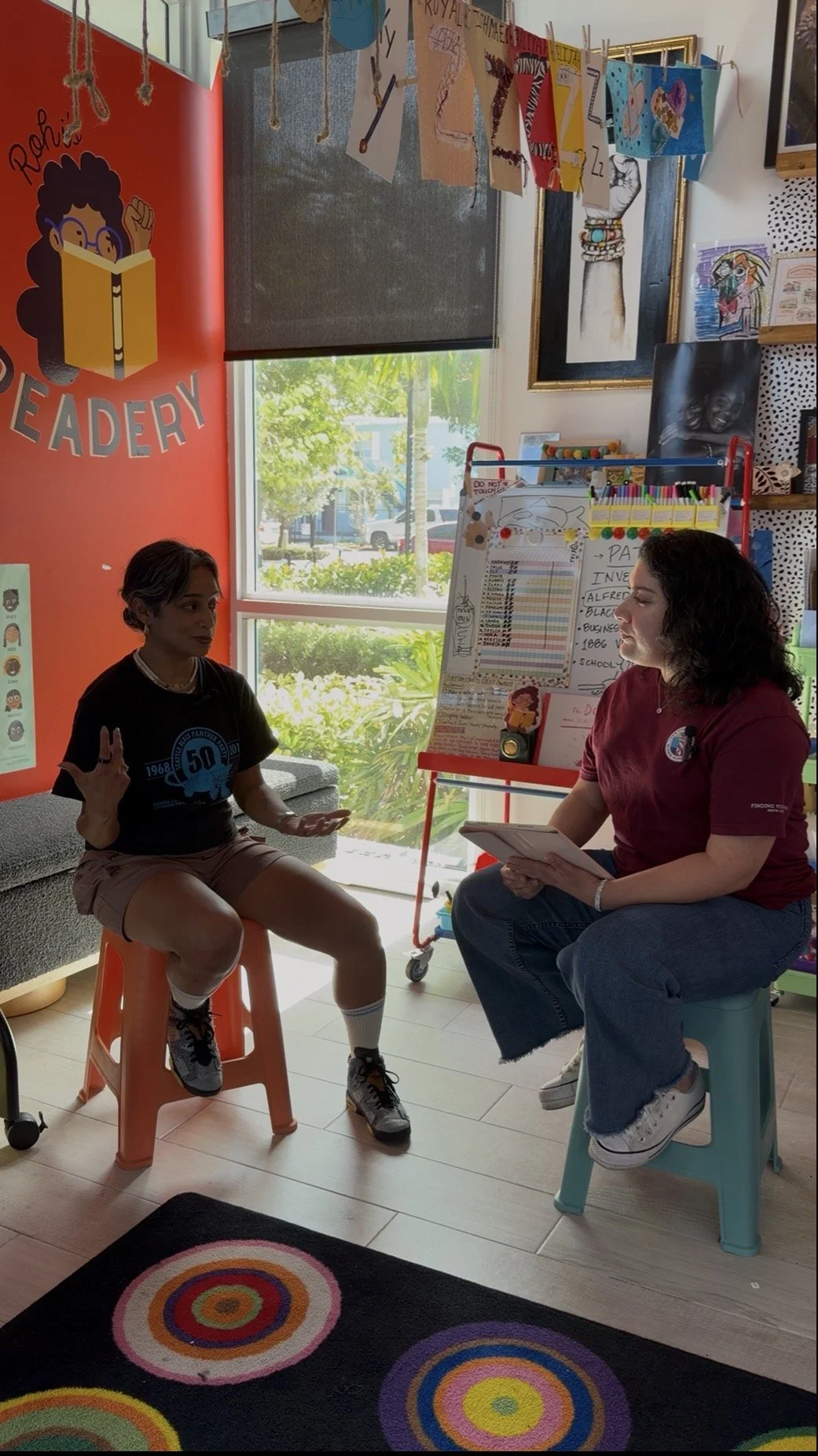
The NASP Practice Model calls on school psychologists to deliver comprehensive, integrated services that extend well beyond assessment and the walls of a single building, services that reach into families, communities, and the systems that shape a child's development. Community organizations doing that work outside the school day are natural partners, and often invisible ones. This spotlight is the first in a series introducing PBASP members to organizations across Palm Beach County whose work intersects with our own.
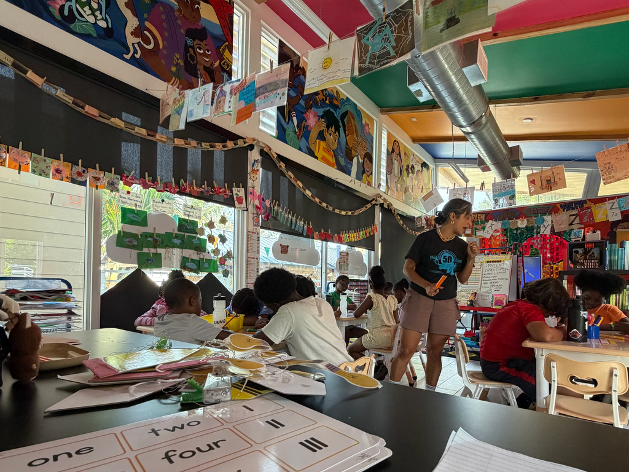
On a summer morning in West Palm Beach's Historic Northwest neighborhood, a row of shotgun-style buildings on 7th Street is thriving. Three age groups of students move between rooms in careful rotation; a reading circle here, a lunch break under the covered patio there, a classroom lesson in between. Children's artwork covers nearly every wall. For a few minutes between transitions, kids are calling to each other, staff are redirecting traffic, and backpacks and books are changing hands. Pranoo Kumar, the founder, has a name for it. "Joyful chaos," she calls it, laughing, "in the best way."
This is Rohi's Readery, a social-justice-driven children's bookstore and learning center serving children and families in the Historic Northwest, and across Palm Beach County.
Restoring Culture
The building itself is part of the story. Rohi's Readery now occupies one of nine shotgun-style structures that make up the Styx Promenade, a roughly $2.6 million project built and restored by the West Palm Beach Community Redevelopment Agency (CRA) along 7th Street, just west of Rosemary Avenue. The design deliberately echoes the architecture of the Styx, the original Black settlement founded in the 1890s by railway and hotel workers recruited to build Henry Flagler's Palm Beach resorts, whose residents were displaced from Palm Beach in the early 1900s and resettled in what are now the Historic Northwest and Pleasant City neighborhoods.
The CRA's intent for the promenade was straightforward: create affordable, owner-occupied retail space that would give small, minority-owned businesses a foothold in the neighborhood, with an emphasis on uses that would genuinely serve the surrounding community, retail, personal services, health and wellness, restaurants, and offices. Owners who won a proposal for space were required to occupy their storefront for at least five years. Rohi's Readery was among the small businesses selected, alongside a second-generation florist, a home health care company, and a soul-food cafe.
The promenade sits near two of the CRA's larger investments in the same revitalization push, Heart & Soul Park, and the recently restored Sunset Lounge, a jazz venue that hosted Ella Fitzgerald, Count Basie, and Louis Armstrong during the Jim Crow era, when segregation barred Black performers from the venues on the other side of the Intracoastal. Together, the park, the lounge, and the promenade are meant to form a single corridor where the neighborhood's history and its present investment sit side by side, and Rohi's Readery, teaching children the history of their own street, is very much part of that design. A student's world doesn't stop at the Readery’s door; it includes the literal ground the program stands on.
Inspired by Ancestors
Rohi's Readery is named for Rohini, Pranoo's grandmother, an education activist who fought for children's rights and for women's emancipation during colonized rule in India. Pranoo's older daughter carries the same name. For Pranoo, the readery is a way of holding both ends of that thread at once, the ancestors and the descendants, and everything a person learns in between, whether it comes from a book, an elder, or a child.
Pranoo's own path to this building was not direct. Her family moved from India to the Deep South in the 1980s, and she grew up navigating discrimination and the quiet cost of assimilation, questions about identity and belonging that she says she didn't fully understand until much later. She went to medical school, left it, moved into nonprofit work, and was laid off during the recession. Pranoo started teaching five- and six-year-olds in Harlem and the Bronx.
"It really saved my life," she says. Watching young children love their own identity, culture, and community gave her, in her words, a kind of permission to reengage with her own.
Years of education consulting followed, much of it with women leaders of color in the field, work where she kept encountering the same burnout and isolation she recognized in herself. When COVID hit and her consulting contracts disappeared, she started asking a different question. What would she want to build for her own child one day? The answer became Rohi's Readery, which opened its doors in 2021, a space, she says, "where whether you are a multigenerational member or someone who just moved here, this is a place for you."
More Than Books
The name suggests a library, and in some ways it is one. As the organization has grown, Pranoo has structured Rohi's Readery as the retail bookshop, while a separate 501(c)(3) nonprofit arm, Rohi's Liberation Station, launched in December 2023 to carry the free programming, book donations, and outreach that had outgrown a single storefront. That structure opened the door to partnerships that only nonprofits can access, including a retired Palm Tran bus that Pranoo is retrofitting into a traveling "Liberation Station," a mobile literacy and storytelling program meant to bring books and workshops to communities beyond the Northwest.
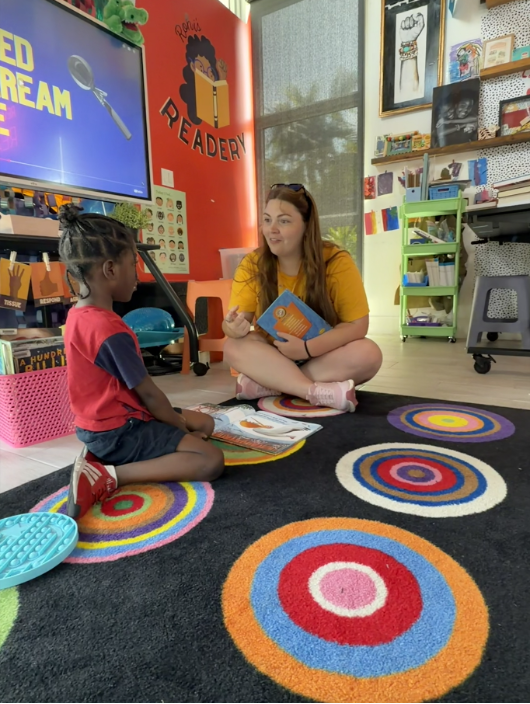
The nearest public library is a genuine walk away, across busy, poorly lit streets with sidewalks that have gone unrepaired, a real barrier in a neighborhood where most children get around on foot. So the Readery built its own access point. Children who fall in love with a book take it home at no cost, in exchange only for a "shelf talker," a short review in their own words posted next to the book for the next reader.
Beyond the books, therapists are on-site as a constant presence, not a pull-out service, woven into the day rather than set apart from it, much like the layered supports many schools now try to build for their own students. Off-site, Rohi's Readery has taught in Belle Glade, Pahokee, Canal Point, and South Bay, and has built more than 250 community partnerships, from the Norton Museum to the Center for Child Counseling, which helps staff the on-site counselors during camp.
Keeping to the Mission
None of this happens without friction. Pranoo is candid that funding is the organization's biggest challenge, not for lack of committed supporters, but because Rohi's Readery has chosen not to soften its language around diversity, equity, inclusion, and anti-racism work, even when that choice has closed off certain funding opportunities. "Those who are really committed to our work," she says, "stand arm in arm with us." The second challenge is more internal, staying a small, sustainable team without burning out the people doing the work.
The Moments that Last
Pranoo tells one story that stays with her. A girl who first came to Rohi's Readery as a young child, one of five siblings, spent last year in and out of fights and unsafe situations. One day she ran into the building barefoot, having just been chased by two adults with guns after a conflict between children escalated. It took the rest of the summer, Pranoo says, to understand whether the girl actually felt safe there.
She did. Staff, a high school intern, and two on-site therapists worked with her together, no one claiming the lead, just responding to what she needed in the moment. It later came out that she'd been missing school to care for a younger sibling who couldn't get placed in a program; Rohi's Readery helped get that sibling enrolled, so the older girl could come back to simply being a kid.
Now 11 and starting her second year at camp, she hasn't been in a fight since. She's leaned further into working with the on-site therapists, and, with a salon next door and a fondness for braiding hair, she's now shadowing local stylists through the Readery's youth entrepreneurship programming, learning what it takes to build a small business from the ground up.
Looking Ahead
Pranoo's hopes for the coming school year center on deepening what already exists, expanding kindergarten-readiness programming for four-to-six-year-olds who might otherwise not have access to early learning, and strengthening wraparound support, academics, mental health, and internships for teenagers who need a different kind of school environment than the one they're in. Pranoo hopes to inspire something new, an adult pipeline, connecting caregivers to job training and nonprofit employment, so that the trust and opportunity Rohi's Readery builds with children extends to their families as well.
"If we can build the trust of our caregivers," she says, "it doesn't just start with the little ones. We have to approach it from all different angles."